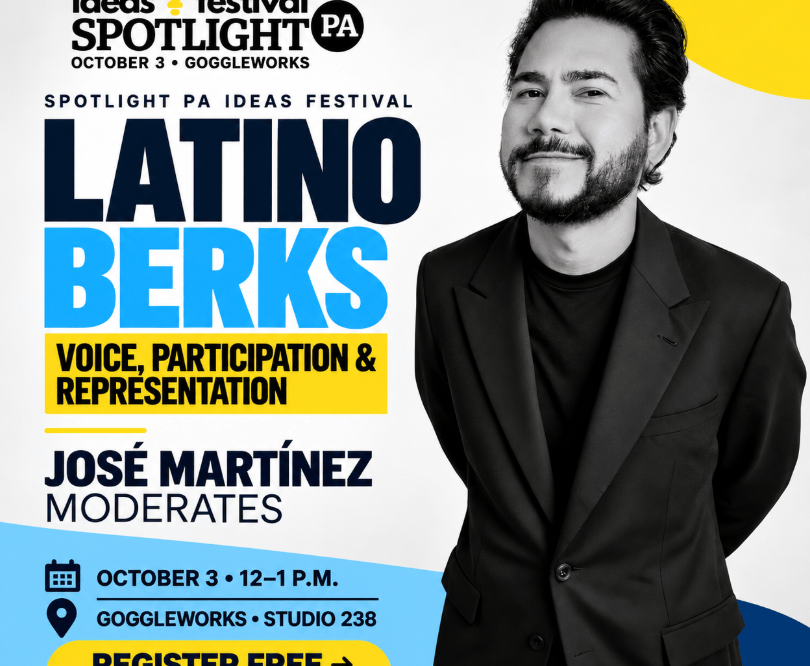
José Martínez will moderate a consequential conversation about voice, civic participation and representation at the 2026 Spotlight PA Ideas Festival.
Latinos are no longer an emerging presence in Berks County. They are business owners, educators, students, journalists, organizers, parents and voters already shaping the region’s identity and future.
Nearly one in four Berks County residents is Latino. In Reading, the community represents a clear majority of the population.
But population is not power.
Being counted does not guarantee being heard. Cultural visibility does not always lead to a seat at the table. And representation means little if the people most affected by public decisions remain absent from the rooms where those decisions are made.
Those tensions will drive Latino Berks: Voice, Participation & Representation, a panel at the 2026 Spotlight PA Ideas Festival moderated by Emmy Award-winning journalist and WFMZ reporter José Martínez.
The conversation will take place Saturday, October 3, from noon to 1 p.m. at the GoggleWorks Center for the Arts in Reading.
“This is not simply a conversation about getting more people to vote,” Martínez said. “It is about whether Latino residents believe their participation matters, whether institutions genuinely listen and whether the community’s growing presence is reflected in leadership and decision-making.”
From Population to Power
The panel will explore how Latino residents are engaging with elections, local government, schools, journalism, community organizations and other institutions that shape everyday life in Berks County and Pennsylvania.
It will also confront difficult questions.
Why do some residents feel disconnected from the political process? Are language and access the biggest barriers—or is distrust more powerful? Do political parties maintain relationships with Latino communities between elections? Are institutions creating genuine opportunities for participation, or merely seeking the appearance of inclusion?
And when Latino voices are invited into public conversations, who is chosen to speak for a community that is diverse in nationality, generation, ideology, language and experience?
“The Latino community is not a monolith,” Martínez said. “There is no single Latino opinion, political agenda or life experience. A meaningful conversation has to recognize that complexity instead of reducing an entire community to voting statistics or campaign strategies.”
Four Perspectives, One Urgent Conversation
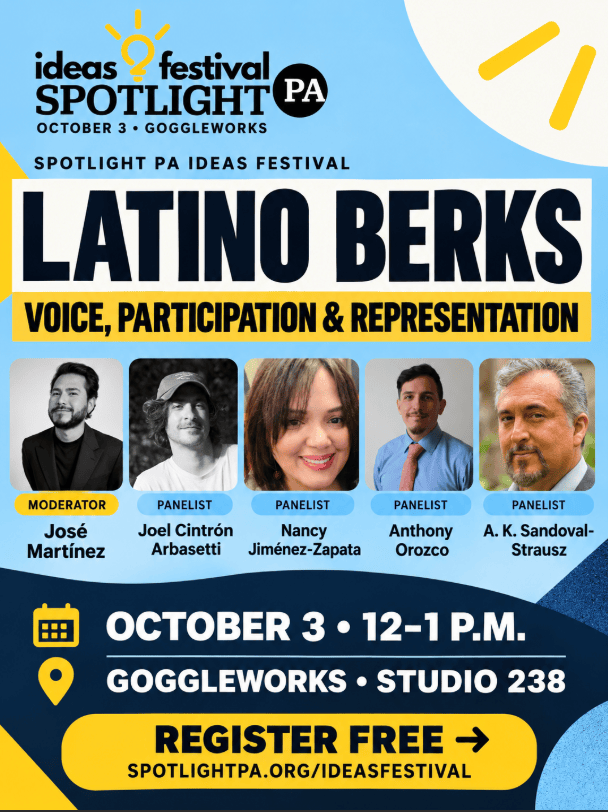
Martínez will be joined by four panelists whose work approaches participation and representation from distinctly different directions.
Joel Cintrón Arbasetti, a reporter with Puerto Rico’s Centro de Periodismo Investigativo, brings the perspective of a journalist whose work examines power, transparency and government accountability. His participation will help connect the experiences of Puerto Rico and the Puerto Rican diaspora with broader questions about citizenship, political influence and access to trustworthy information.
Nancy Jiménez-Zapata, field coordinator for Make the Road Pennsylvania, works directly with residents on voter engagement, civic participation and issues affecting immigrant and working-class communities. Her experience offers an on-the-ground understanding of why people participate, why some remain skeptical and what it takes to build trust beyond a single election.
Anthony Orozco, director of operations and communication at Barrio Alegría, works at the intersection of art, storytelling and neighborhood leadership. His perspective expands the definition of civic engagement beyond the ballot box to include culture, creativity and community-led action.
A. K. Sandoval-Strausz, director of Latina/o Studies and professor of history at Penn State University, studies immigration, cities and the role Latino communities have played in transforming urban America. He will bring historical context to a demographic shift too often described as new or sudden.
Together, the panelists will examine not only what prevents participation, but what meaningful representation could look like in practice.
More Than Election-Day Outreach
Latino voters have become increasingly important in Pennsylvania, particularly in communities along the Reading–Allentown corridor. Yet political attention does not always translate into sustained engagement.
Campaigns may advertise in Spanish, open temporary outreach offices or highlight Latino supporters. But the deeper test comes after Election Day: Who continues listening? Who follows through? Who appoints Latino leaders, invests in trusted community organizations and makes public systems easier to navigate?
The same questions extend beyond politics.
Do school boards reflect the families they serve? Are public meetings accessible to working residents? Does local journalism consistently report with Latino communities rather than merely about them? Are young people able to see a path from community involvement to leadership?
And are institutions willing to share power—or only visibility?
“Representation cannot be limited to seeing a Latino face in a photograph,” Martínez said. “It means having a meaningful voice when priorities are set, resources are distributed and decisions are made.”
A Conversation With the Community
The session will not treat the audience as passive observers. Attendees will have an opportunity to bring their own questions and experiences into the discussion.
The goal is not to leave with one definition of Latino political power or one solution to every barrier. It is to identify practical pathways toward stronger participation—and to ask what responsibility belongs to government, schools, political organizations, the media and Latino residents themselves.
“Berks County is changing, but this is about more than demographic change,” Martínez said. “It is about whether our civic institutions are changing with it.”
The future of Berks County will be shaped by its Latino residents.
The real question is whether they will also have the power to shape the decisions that define it.
Event Information
Latino Berks: Voice, Participation & Representation
Moderator: José Martínez, Reporter, WFMZ
Date: Saturday, October 3, 2026
Time: Noon–1 p.m.
Location: GoggleWorks Center for the Arts, Studio 238
Admission: Free
Register at spotlightpa.org/ideasfestival.
Discover more from José Martínez
Subscribe to get the latest posts sent to your email.

